
Open Mon - Sat
10am - 5pm

The latest..
Can we have your stone?

The museum roundhouse will be built partly from stone. We will need at least 40 tonnes of stone. The roundhouses around Gairloch are built from local stone; stuff left on or near the surface of the ground after the last ice age. Ideally, we want to build with the same kind of stone people would have used 2000 years ago (i.e. not quarried, not dressed). If you have stone in your garden, or on your land that you would like to donate / have removed / get rid of, please send us the details using this form or phone the museum on 01445 712287.
The museum’s priority is looking after local heritage so we’d prefer not to take down old walls, byres etc unless they’re REALLY far gone and are not a significant part of crofting heritage.
-
Stone will be removed carefully, probably by hand + vehicle and trailer, perhaps using a digger if there’s a lot to deal with on one site (and it’s accessible). Our dyker will coordinate with you to make sure everything is done safely.
-
Pick up will take place over the winter, once the roundhouse site has been made ready for drop off.
-
We’re also very interested in any stories associated with the stone. We’d love to hear about where it comes from, what it used to be, who worked with it.
Online form: The form is managed by the Museum. We use Tally to make forms, and the data saved will only be accessible to museum staff and our dyker, Neil Davidson.

Kenneth McLean, Coinneach 'an a' Choinnich, of Lonmore, father of A' Mhican. He lived to one hundred years, dying in 1905. He was a master stonemason, and built the stonewall from Gairloch Free Church to Flowerdale, and the old Gairloch Pier. Picture published by J. G. MacDonald, the Seminary, Stornoway.
The Roundhouse Project
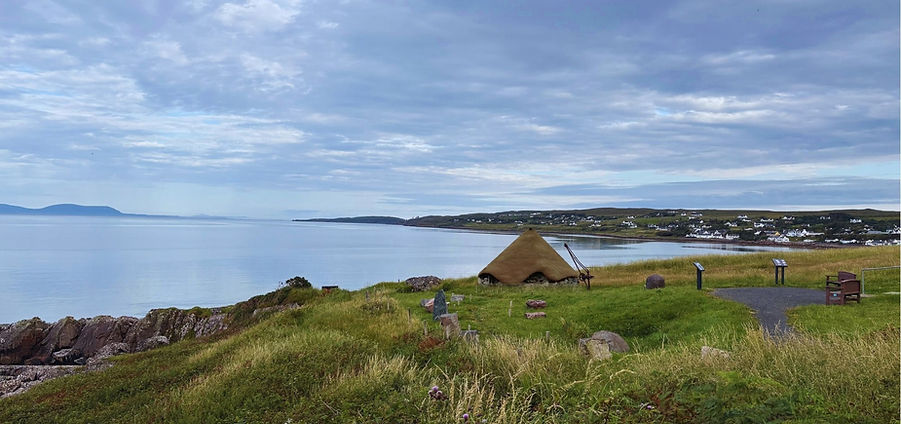
Gairloch Museum is developing plans to build a full-scale reconstructed Iron Age roundhouse to be part of the Outdoor Museum. Based closely on the archaeological evidence from Achtercairn, we will build the roundhouse using traditional techniques and local materials. It will serve as a new space for education, heritage, and community use - and link to the earliest settlements in our area:
People have lived and farmed on Achtercairn, above the Museum, for nearly 5000 years. In prehistoric times, nearly 200 roundhouses were sited within 20 miles of Gairloch. Today, all that can be seen in the landscape are low circles of collapsed stone. The roundhouse project aims to bring this prehistoric past to life.
The roundhouse will not be a static exhibit but a working space. Designed to host school sessions, museum programming, community activities and informal drop-in use, it will be freely available to local groups for non-profit events. We want it to feel rooted in place and useful to the people who live here.
The project will also provide opportunities for training in traditional skills. Working with local and national craftspeople, we are planning a series of short courses in drystone walling, greenwood joinery and thatching. These will run in the months leading up to the build, with some participants going on to help construct the roundhouse itself. We will also offer a fully-funded traditional skills placement for a local school-leaver.
With planning permission approved in January 2026, we were delighted in April 2026 to hear that £45,000 has been awarded to the project from the Scottish Government through the Highland Council Community Regeneration Fund. While we eagerly await news from other funders, this support brings the project much closer to becoming a reality. We are incredibly grateful to everyone in the community who has fed into the plans thus far and are really excited to progress with our next steps to bring this project to fruition.
We aim for the construction phase to take place from June to October 2027. Building the roundhouse will be an act of living heritage: we will be sourcing local natural materials; rediscovering and sharing traditional skills while recreating an historic building form set in its natural landscape. We have a team of skilled craftspeople - heather thatchers, turf builders, traditional joiners and dry stone dykers - lined up for the hoped-for build and will share news of our progress and chances to get involved as this year unfolds. Our energy and efforts are now directed to securing funding for this exciting project.
If you’d like to get involved - by volunteering, sharing your knowledge, attending a training course or offering feedback - we’d love to hear from you.